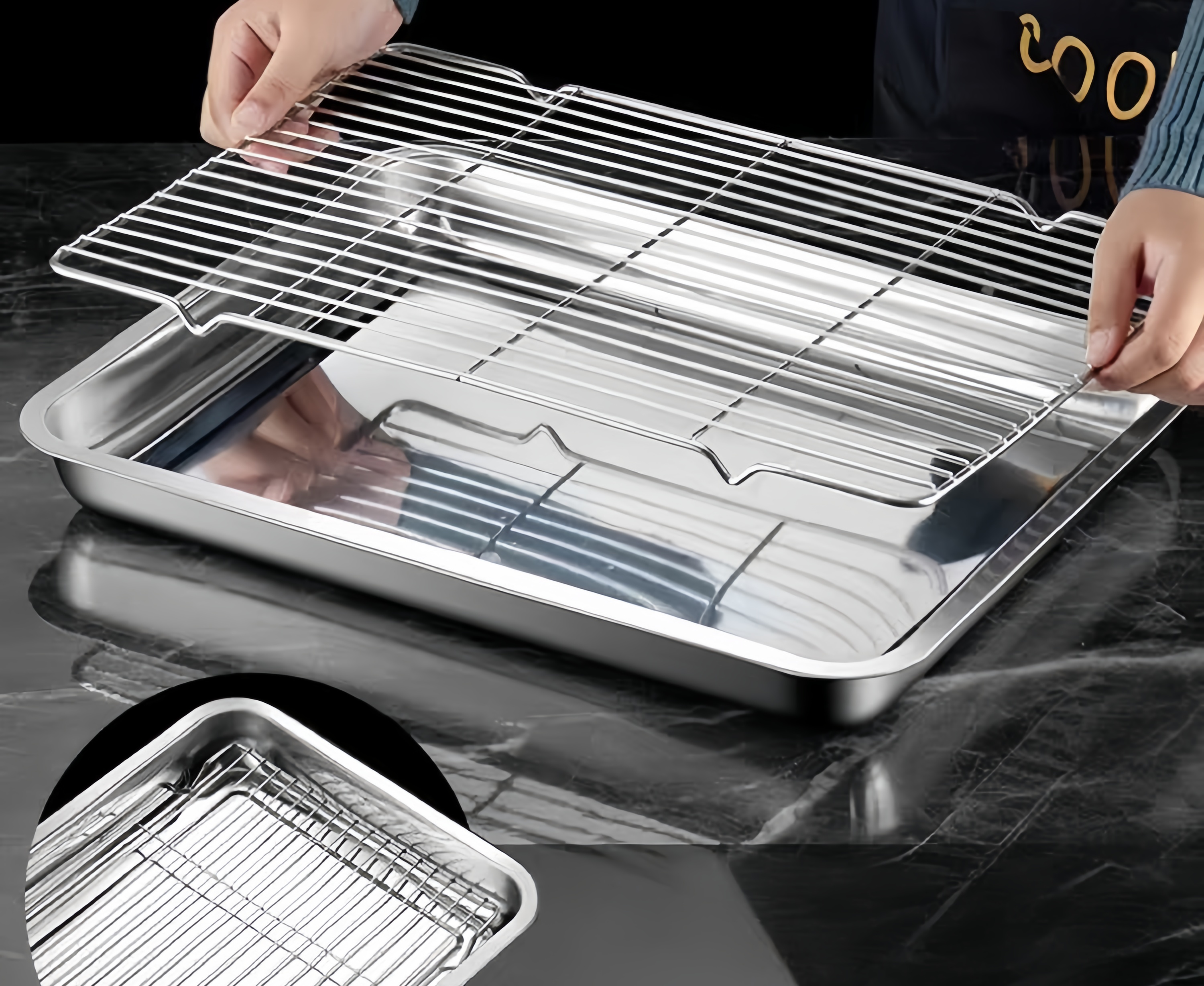

Correct stainless steel cooling rack spacing helps balance food support, airflow, product strength and cleaning requirements. However, there is no single wire spacing suitable for every bakery or food-processing application.
A rack used for small cookies may require closer wires than one used for bread, cakes or filled baking trays. Importers should therefore specify the product according to the actual food size, equipment and expected load rather than ordering only by overall length and width.
The following six factors can help commercial buyers choose a suitable wire arrangement.
Why Is Stainless Steel Cooling Rack Spacing Important?
Wire spacing determines how much open area is available between the supporting wires. Wider spacing creates a more open structure, while closer spacing provides more contact points beneath the food.
The choice may affect:
Support for different food sizes
Air movement around the product
Rack weight and material usage
Cleaning accessibility
Load distribution
Production cost
Compatibility with trays and equipment
Buyers should evaluate these factors together. Selecting the smallest or largest available spacing without considering the application can create unnecessary cost or performance problems.
1. Match the Spacing to the Food Size
The food product should not sag, tilt or fall between the supporting wires. Small cookies, pastries and delicate products generally require closer spacing than large bread loaves or cakes.
The product’s dimensions before and after baking should both be considered. Dough may spread, shrink or change shape during processing. Buyers should test representative products instead of relying only on catalogue photographs.
When a cooling rack supports a separate baking pan or tray, the rack spacing can sometimes be wider because the pan distributes the load. However, the support positions must still match the base of the tray.
For customized orders, provide the manufacturer with the minimum product size and information about whether food will contact the rack directly.
2. Balance Airflow and Product Support
An open rack structure allows air to move around more of the product surface. This can help prevent moisture from remaining beneath baked goods during cooling.
However, wider spacing is not automatically better. If the food lacks sufficient support, it may become marked or deformed. Closer wires provide more support but create additional contact areas.
The best stainless steel cooling rack spacing balances open area with stable food support. Actual cooling performance also depends on room temperature, air velocity, food type, batch size and rack arrangement.
Commercial buyers should test the rack under their real production conditions before confirming a large order.
3. Consider Wire Diameter and Load Capacity
Wire spacing cannot be evaluated separately from wire diameter. Wider gaps may require stronger wires or additional support bars to maintain the required load capacity.
A rack designed for lightweight cookies has different structural requirements from one carrying large bread products, meat, trays or industrial food-processing loads.
Buyers should provide:
Expected load per rack
Whether the load is evenly distributed
Maximum operating temperature
Frequency of use
Required deflection limit
Whether racks will be stacked
The outer frame and internal reinforcement must also match the overall rack dimensions. Large racks may require crossbars or center supports to reduce sagging.
4. Confirm Rack Height and Clearance
Cooling racks often include feet or a raised frame to create clearance underneath the food. This lower space allows air to reach the bottom surface and prevents the product from resting directly on a table or tray.
Buyers should specify the required rack height and check whether the feet interfere with baking pans, worktables, storage shelves or washing equipment.
If multiple racks will be stacked, the manufacturer needs to know the required vertical clearance and stacking method. Uneven feet can make the rack unstable, so sample inspection should include a flatness and rocking test.
Our Stainless Steel Baking Cooling Rack can be customized according to the required dimensions, wire spacing, wire diameter, frame structure and support height.
5. Check Compatibility with Existing Equipment
A custom cooling rack may need to fit inside a specific oven, baking tray, trolley, cabinet or production line. Overall dimensions alone may not be sufficient.
The buyer should also confirm:
Internal equipment width and depth
Door and guide-rail clearance
Corner radius
Required insertion direction
Stopper or locating-point positions
Maximum permitted height
Acceptable dimensional tolerance
If the rack slides into guide rails, measure the rail distance at more than one location. Used equipment may not remain perfectly square, so a small installation allowance may be necessary.
Providing a technical drawing, photograph or physical sample helps reduce the risk of receiving racks that cannot be installed correctly.
6. Consider Cleaning and Food-Contact Requirements
Closer spacing creates more wire intersections and may require more cleaning attention. Welded joints should be consistent, and the finished surface should not contain obvious burrs, open crevices or difficult-to-clean residue.
Material and surface requirements depend on the destination market and intended application. Buyers should clearly specify the stainless steel grade, surface treatment and any required documentation.
Commercial food-equipment standards commonly evaluate material safety, cleanability, design and construction. Buyers can review NSF food-equipment certification information when developing their purchasing requirements.
A manufacturer should not describe a product as NSF-certified unless the specific product has completed the applicable certification process.
Information to Include in an RFQ
When requesting a quotation, provide:
Overall length and width
Stainless steel grade
Wire spacing
Wire diameter
Outer-frame diameter
Support-bar structure
Rack or foot height
Expected load
Operating temperature
Surface treatment
Required tolerances
Order quantity
Packaging method
Drawing or sample
Complete information allows suppliers to compare the same specifications and provide more accurate quotations.
Approve the Stainless Steel Cooling Rack Spacing
Before mass production, buyers should approve a sample for any new rack design. The sample should be tested with the actual food, tray or equipment.
Check food support, airflow, dimensions, stability, welding, surface quality, cleaning accessibility and load performance. Once approved, record the final stainless steel cooling rack spacing and other dimensions in a signed drawing or inspection sheet.
LittleMonkey Metal manufactures customized stainless steel baking and cooling racks for commercial bakeries, food processors, equipment brands, importers and wholesalers. Dimensions, wire spacing, frame construction and surface treatment can be produced according to purchasing requirements.