
Many buyers choose a grill mesh by diameter or overall shape, then discover that the opening size has a bigger effect on daily cooking than expected. A mesh that works well for steak may be frustrating for shrimp. A rack that holds vegetables securely may restrict airflow when it is used for larger cuts of meat.
The right BBQ grill mesh opening creates a practical balance between food support, heat circulation and cleaning effort. For restaurants, catering companies, outdoor cooking brands and importers, this detail also affects product returns and customer satisfaction.
This guide explains how to match opening size with food type, why wire diameter matters, and which questions to answer before ordering a custom grill mesh.
1. What Does Grill Mesh Opening Mean?
Mesh opening is the clear distance between adjacent wires. It is not the same as the wire diameter or the outside dimension of the grill.
For a woven or welded mesh, the opening determines how much of the food is supported and how freely heat and smoke can pass through. A smaller opening provides more contact points, while a larger opening leaves more space for airflow and direct heat exposure.
Opening is normally specified in millimeters, such as 10 x 10 mm, 15 x 15 mm or 20 x 20 mm. For a square rack, both directions are usually the same. For a special design, the opening can be rectangular or arranged as parallel bars.
2. Match the Opening to the Food You Cook
There is no universal “best” opening. The correct size depends on the smallest pieces that must stay on the grill and on the cooking temperature used by the operator.
Small foods: choose closer spacing
Shrimp, sliced mushrooms, diced vegetables, meatballs and other small foods need enough support to prevent pieces from slipping through. Openings around 8–12 mm are often a practical starting point for these applications.
Closer spacing also helps when food is turned with a spatula instead of tongs. It creates a more stable surface and reduces the amount of food that falls into the fire.
Mixed skewers and medium-size portions
For chicken pieces, sausage, fish fillets and mixed vegetables, a medium opening can provide a useful compromise. Openings around 12–20 mm allow heat and smoke to circulate while still supporting most common portions.
Before selecting this range, consider whether the product will be used for loose ingredients or food arranged on skewers. Skewers already hold the pieces together, so a slightly larger opening may be acceptable.
Large cuts and high-airflow cooking
Steaks, whole fish, ribs and large vegetables do not need as many support points. A larger opening or a straight-bar configuration can expose more surface area to the heat and create the seared pattern many customers expect.
Large openings are less suitable for foods that soften during cooking. A fillet that is firm when raw may break apart as it becomes tender, so the final cooked texture should be part of the selection decision.
3. Why Wire Diameter Changes the Result
Opening size cannot be evaluated by itself. Wire diameter affects the strength, heat retention and visual cooking mark of the mesh.
Thicker wire generally provides a stronger and more durable cooking surface. It is useful for heavy food loads, repeated commercial cycles and larger frame dimensions. It can also leave a more pronounced contact mark on food.
Thinner wire creates a lighter product and can increase the open area available for heat and smoke. However, it may be less suitable for rough handling or high loads unless the frame and support structure are designed to compensate.
For many food-service applications, a 1.8 mm or 2.5 mm mesh wire is a starting point, with the final choice adjusted for opening size, span and expected load. A manufacturer can recommend a combination after reviewing the cooking equipment and food weight.
4. The Frame Keeps the Opening Consistent
An accurate opening is only useful when the frame remains flat. A weak perimeter can twist during heating, washing or transport, changing the distance between wires and creating uneven contact with the food.
A rigid stainless steel frame supports the mesh and makes it easier to position on a grill, oven shelf or cooking line. Frame thickness should be selected according to the rack dimensions and the load it must carry. Larger square or rectangular products usually need more reinforcement than small household racks.
Weld quality matters as much as the nominal frame size. Clean, continuous welds reduce movement between the mesh and frame, while smooth edges make the product safer to handle and easier to wash.
5. Square Mesh Is Useful Beyond BBQ
Round grill meshes fit circular fire bowls, but square and rectangular designs often make better use of oven shelves and commercial work surfaces. They can be lined up side by side, stacked for storage or loaded in standard baking equipment.
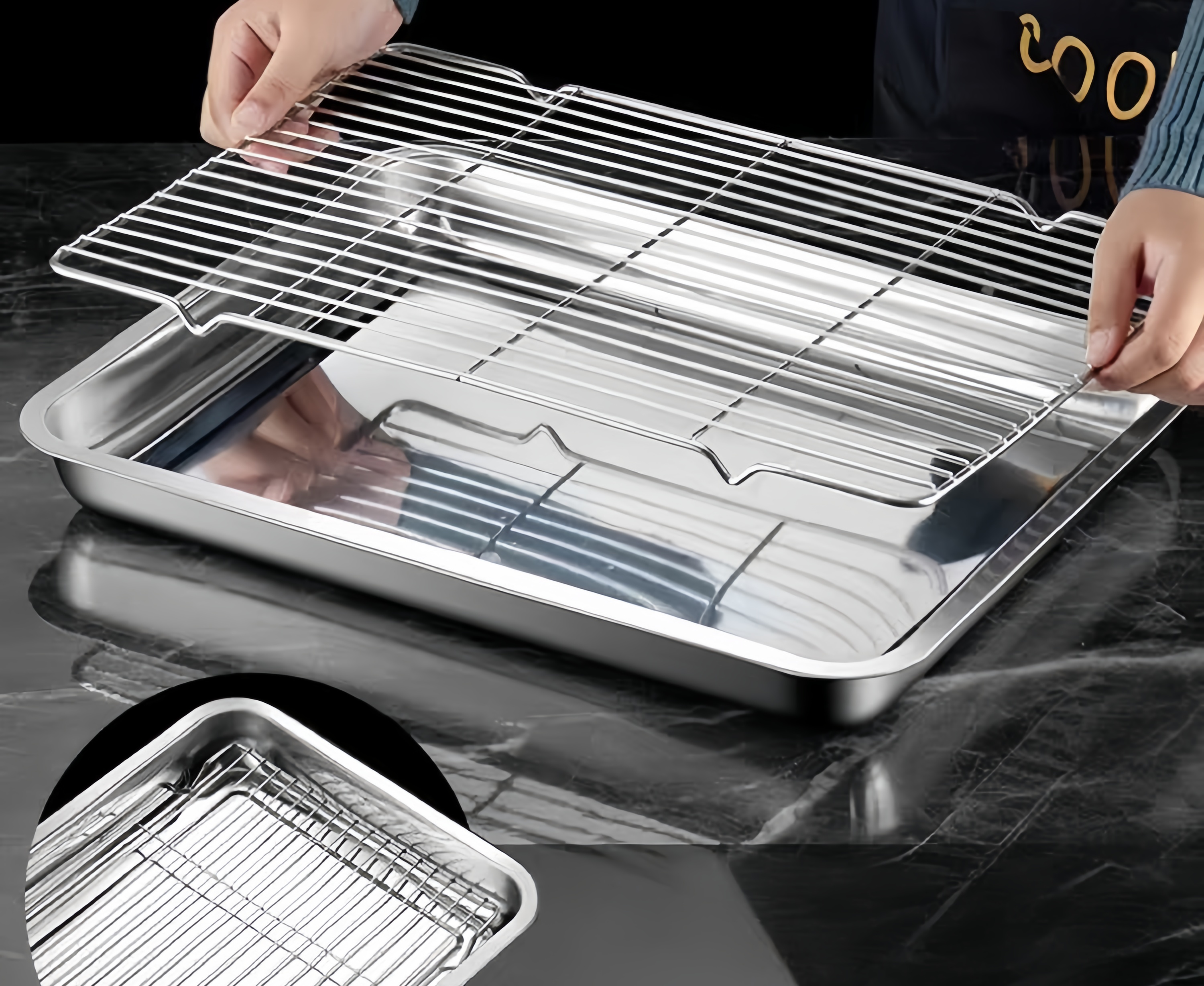
This is why a square stainless steel grill mesh and oven rack can serve several workflows: charcoal grilling, oven baking, cooling, roasting and food preparation. A square footprint also makes it easier to arrange portions in rows, estimate batch capacity and transfer food between stations.
For private-label products, the square format offers room for branding through packaging while keeping the physical design familiar to distributors and end users.
6. A Simple Test Before Mass Production
A short product test can prevent an expensive mismatch. Buyers should test the mesh with the actual food and equipment rather than relying only on a drawing.
Use the following sequence:
- Place the empty mesh on the intended grill or oven shelf and check that it sits flat without rocking.
- Load the smallest food pieces the product must hold.
- Observe whether food touches the heat source or falls through when the mesh is lifted.
- Turn or transfer the loaded mesh using the normal kitchen tools.
- Check browning, smoke circulation and cooking time against the current equipment.
- Cool and clean the mesh, then inspect the welds, corners and surface for residue.
The test should include the heaviest expected load and at least one delicate food. This reveals both structural and opening-size problems before production is approved.
7. Questions to Include in a Supplier RFQ
An accurate request for quotation helps suppliers recommend a workable design instead of pricing an incomplete specification. Include:
| Requirement | Detail to Provide |
|---|---|
| Food type | Small pieces, fillets, steaks, vegetables or mixed foods |
| Equipment | Charcoal grill, gas grill, oven, smoker or conveyor line |
| Opening | Target clear opening in millimeters |
| Wire diameter | Required strength or preferred starting range |
| Overall size | Length, width, diameter and usable cooking area |
| Frame | Thickness, shape, corner style and reinforcement |
| Material | 304 or 201 stainless steel according to use and market |
| Finish | Electropolished, smooth welded or another approved finish |
| Quantity | Sample quantity, trial order and estimated annual volume |
| Packaging | Bulk carton, individual pack or private-label packaging |
If the product must fit a specific oven shelf or grill grate, provide the clear internal dimensions, not only the nominal model name. A drawing, photograph or physical sample can help the manufacturer confirm tolerances and edge clearance.
8. Cleaning and Food-Safety Considerations
Smaller openings create more wire intersections, which may require a little more brushing after cooking. Larger openings are often faster to clean, but grease can still collect where the mesh joins the frame.
A smooth electropolished stainless steel surface helps reduce residue adhesion and supports routine washing. Avoid abrasive tools that can scratch the surface. After cleaning, rinse away detergent and dry the rack fully before storage.
Commercial users should inspect the mesh on a regular schedule. Replace a rack if wires are broken, welds have opened or the frame no longer sits flat. A damaged surface can create hot spots and make food release less predictable.
Frequently Asked Questions
What is a good opening for shrimp and small vegetables?
An opening around 8–12 mm is a useful starting point for small foods, but the final size should be checked with the actual portion dimensions and cooking method.
Does a smaller opening cook food faster?
Not necessarily. A smaller opening supports food across more contact points, while a larger opening can improve direct heat and airflow. Cooking speed also depends on wire diameter, fuel, temperature and food thickness.
Can the opening be customized for a private-label product?
Yes. Buyers can usually request a custom opening, wire diameter, frame thickness and overall size. Confirm the drawing and sample before approving mass production.
Is 304 stainless steel always required?
304 stainless steel is commonly selected for demanding food-service use because of its corrosion resistance. 201 stainless steel may suit cost-sensitive or moderate-frequency applications when it meets the buyer’s market and compliance requirements.
Final Takeaway
Mesh opening is a performance decision, not just a visual detail. Match the clear opening to the smallest food piece, then verify the wire diameter, frame strength and equipment fit with a real cooking test.
For wholesale, OEM and commercial projects, a complete specification helps the manufacturer balance food support, heat circulation, cleaning and service life. The result is a grill mesh that works consistently from the first sample through repeated production batches.