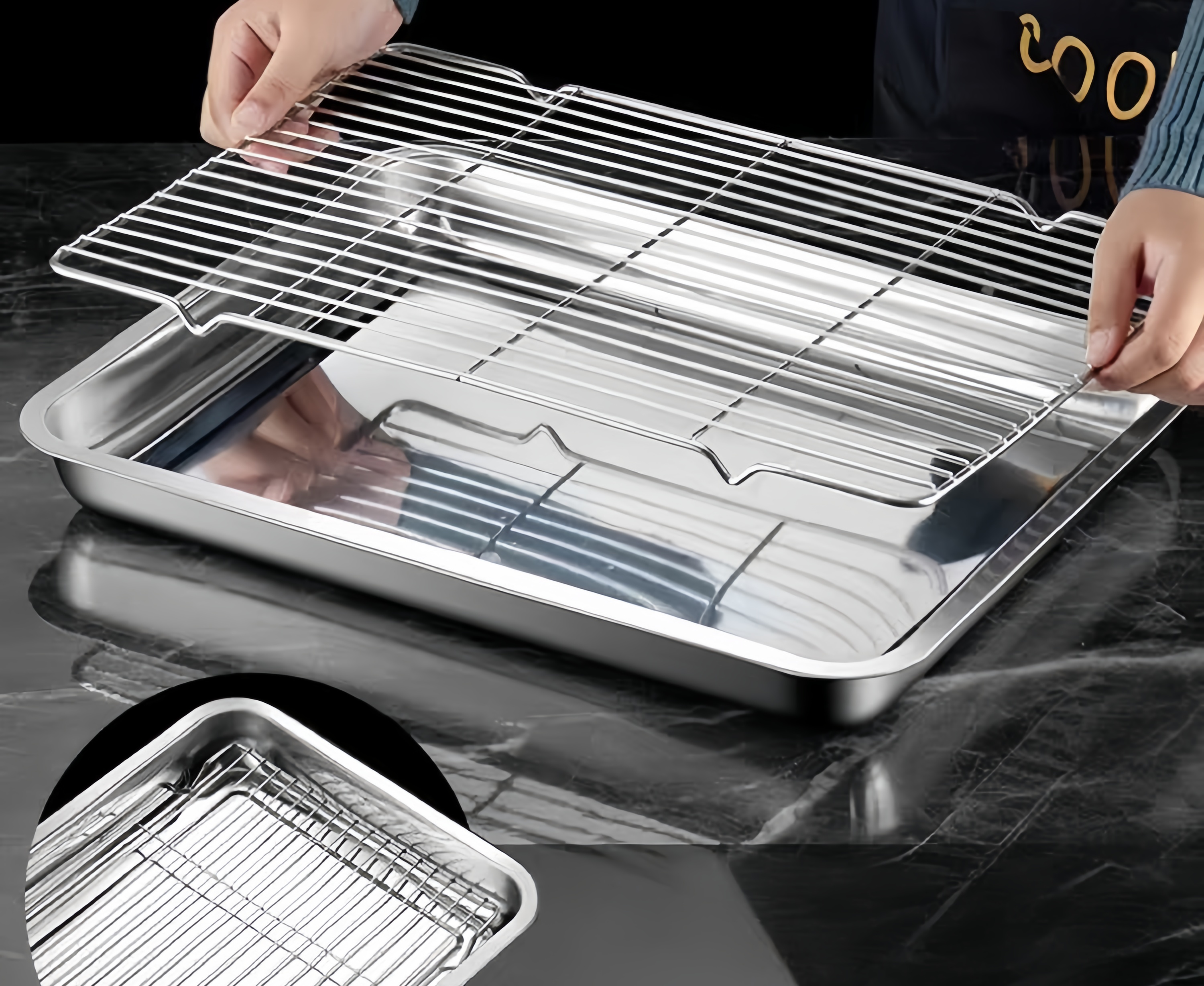

Ordering a custom stainless steel wire rack requires more information than simply providing the product length and width. Material grade, 와이어 직경, mesh opening, frame structure, surface finish, load requirements, and application environment can all affect product performance and manufacturing cost.
For wholesalers, food-equipment manufacturers, distributors, and commercial buyers, providing complete specifications helps the supplier prepare a more accurate quotation and recommend a suitable rack structure.
This guide explains the main details buyers should confirm before requesting an OEM stainless steel wire rack quotation.
1. Explain the Intended Application
The first step is to tell the manufacturer how the rack will be used.
A stainless steel wire rack may be designed for:
- BBQ grilling
- Baking and cooling
- Commercial ovens
- Food drying
- Fruit and vegetable dehydration
- Meat or seafood processing
- Restaurant kitchens
- Food-processing equipment
- General industrial applications
Different applications require different levels of heat resistance, corrosion resistance, airflow, load capacity, and structural strength.
For example, a lightweight cooling rack may not require the same wire thickness as a heavy-duty BBQ grill grate. A drying tray may require smaller mesh openings to support small food products, while an oven rack may require a reinforced frame.
2. Select the Stainless Steel Material
Material selection affects corrosion resistance, appearance, service life, and price.
Common options include:
304 스테인레스 스틸
304 stainless steel is commonly selected for commercial kitchens, baking equipment, food-processing applications, and products exposed to frequent washing or moisture.
It offers strong corrosion resistance and is suitable for many demanding commercial environments.
201 스테인레스 스틸
201 stainless steel can be a more economical option for cost-sensitive projects, particularly when the rack is used in relatively dry or less demanding conditions.
Buyers should explain the operating environment rather than selecting material based only on price. The manufacturer can then recommend an appropriate option.
3. Provide the Overall Dimensions
The buyer should provide the exact:
- Length
- Width
- Diameter for round racks
- Overall height
- Required manufacturing tolerance
Dimensions may be supplied in millimetres or inches, but the measurement unit must be clearly marked.
When the rack needs to fit an existing oven, tray, machine, or production line, buyers should also provide the internal equipment dimensions and required clearance.
A technical drawing is the most reliable way to prevent misunderstanding.
4. Confirm the Wire Diameter
Wire diameter directly affects rack strength, weight, and cost.
Thinner wire may be suitable for lightweight cooling or drying applications. Thicker wire provides greater structural strength for heavier food products, repeated commercial use, or high-load applications.
Little Monkey commonly manufactures mesh structures using wire diameters such as:
- Approximately 1.8 mm for standard structures
- Approximately 2.5 mm for heavier-duty designs
Other wire diameters may be produced according to customer requirements.
The correct choice depends on rack size, load requirement, mesh design, and supporting frame.
5. Specify the Mesh Opening
Mesh opening determines airflow and the level of product support.
Smaller mesh openings are suitable for:
- Small baked goods
- Small food pieces
- Fine drying applications
- Products that may fall through larger openings
Larger mesh openings provide:
- Increased airflow
- Faster cooling
- Improved heat circulation
- Easier removal of larger food residues
A commonly used mesh opening may be approximately 10 × 10 mm, but mesh size can be customized according to the product and application.
Buyers should provide both the opening size and the required wire arrangement whenever possible.
6. Define the Frame Structure
The outer frame supports the mesh and helps the rack maintain its shape.
Important frame specifications include:
- Frame diameter or thickness
- Single or reinforced frame
- 둥근, square, or rectangular shape
- Cross-support wires
- Raised edges
- Support legs
- Single or double handles
- Required load capacity
Larger racks usually require stronger frames or additional supporting wires.
If the rack will be lifted while carrying food or equipment, the handle structure and welding strength must also be confirmed.
7. Choose the Surface Finish
Surface treatment affects appearance, smoothness, cleanability, and corrosion performance.
Electropolishing is commonly used for stainless steel wire products. It can create a brighter, smoother, and more uniform surface while improving the appearance of welded wire structures.
Buyers should clearly state whether they require:
- Electropolishing
- Standard stainless steel finish
- Mechanical polishing
- Another specified surface treatment
Surface treatment cannot correct an unsuitable product design, so welding quality, dimensions, and structure must be controlled before finishing.
8. Confirm Quantity, Packaging, and Sample Requirements
Order quantity affects production planning, packaging, and pricing.
Before requesting a quotation, provide:
- Estimated order quantity
- Sample quantity
- Individual or bulk packaging requirements
- Carton dimensions or weight limits
- Labelling requirements
- Shipping destination
- Required delivery time
For customized products, a sample may be produced before bulk manufacturing so that the buyer can confirm dimensions, material, welding, and surface finish.
9. Send a Drawing or Reference Sample
A drawing is strongly recommended for customized stainless steel wire racks.
The drawing should include:
- Overall dimensions
- Wire diameter
- Mesh opening
- Frame thickness
- Handles or legs
- Weld positions
- Required tolerance
- Material grade
- Surface treatment
When a drawing is unavailable, buyers may provide clear photos, a physical sample, equipment dimensions, and a detailed written description.
The more complete the information, the easier it is for the manufacturer to prepare an accurate quotation.
Choosing a Custom Stainless Steel Wire Rack Manufacturer
A reliable manufacturer should be able to review the buyer’s application, identify missing specifications, and recommend a practical manufacturing solution.
Little Monkey manufactures stainless steel grill mesh, baking and cooling racks, drying racks, 오븐 선반, and custom wire mesh products.
Available customization options include:
- 201 or 304 스테인레스 스틸
- Custom length, 너비, or diameter
- Different wire diameters
- Custom mesh openings
- Reinforced frames
- Handles and support legs
- Electropolished surfaces
- OEM production according to drawings or samples
Conclusion
A successful custom stainless steel wire rack order begins with a clear specification.
Before requesting a quotation, buyers should confirm:
- Application
- 재료
- Overall dimensions
- Wire diameter
- Mesh opening
- Frame structure
- Surface finish
- Quantity
- Packaging
- Drawing or reference sample
Providing this information helps reduce communication errors and allows the manufacturer to recommend the correct structure for the intended commercial application.
Contact Little Monkey with your drawing, dimensions, product application, and required quantity to receive a customized manufacturing proposal and quotation.