The first order is not always the most difficult order.
A supplier may produce an acceptable sample and a successful initial shipment, but importers also need to know what will happen six months later. Will the next shipment use the same wire diameter? Will the rack still fit the customer’s equipment? Will the welding positions, surface finish and packaging remain consistent?
Maintaining quality across stainless steel wire rack repeat orders requires more than sending the previous purchase order again. Buyers and manufacturers need a controlled product standard that can be used every time production restarts.
The following eight checks can help importers reduce unexpected changes between samples, first orders and future batches.
Why Can Repeat Orders Be Different?
A repeat order may appear identical in the purchasing system while production conditions have changed.
Possible causes include:
- An old drawing being used
- A new raw-material batch
- Different production fixtures
- Machine-setting changes
- Replacement of a component
- Different welding operators
- A revised surface-treatment process
- New packaging materials
- Unrecorded instructions from earlier messages
These changes do not automatically mean the product will be defective. However, they can create variation if the approved requirements are not clearly documented.
The solution is to establish one controlled reference for the product and review it before each repeat order.
1. Use a Revision-Controlled Drawing
The latest approved drawing should be the main technical reference for every order. It should show more than the overall length and width.
Depending on the product, the drawing may include:
- Overall dimensions
- Wire diameter
- Frame diameter
- Mesh opening or bar spacing
- Reinforcing-wire position
- Handle or support-leg dimensions
- Welding locations
- Permitted dimensional variation
- Surface-treatment requirement
- Drawing revision number
- Approval date
A revision number is especially important when the design has been changed after sampling or during the first production run.
For example, the buyer may have requested a stronger frame, a different support position or a smaller overall dimension. If this change exists only in an email or chat message, the next production team may not know which instruction is current.
Each repeat purchase order should refer to the latest approved drawing revision.
2. Keep an Approved Reference Sample
An approved sample provides a physical reference for features that may be difficult to describe completely in a drawing.
It can help both parties compare:
- General construction
- Wire arrangement
- Welding appearance
- Edge finishing
- Surface condition
- Product balance
- Handle position
- Support-leg stability
The sample should be identified with the product code, approval date and drawing revision. It should also be stored carefully to prevent damage or confusion with an unapproved sample.
However, the approved sample should not replace written specifications. A physical sample can become scratched, bent or lost, and some properties cannot be confirmed visually.
The best approach is to use the approved drawing, written requirements and reference sample together.
3. Confirm the Material Again
The words “same as last order” may not be enough when material is important to the application.
Each purchase order should repeat the agreed stainless steel grade and identify whether the same requirement applies to the inner wires, frame, handles, legs and reinforcing components.
Buyers may also need to reconfirm:
- Required stainless steel grade
- Wire specifications
- Surface condition
- Material documentation
- Whether material substitutions are permitted
- Whether approval is required before a substitution
A manufacturer should not silently replace an agreed material simply because another material is available.
If the buyer requires supporting material documents, this requirement should appear on every applicable order rather than only on the first inquiry.
4. Protect Critical Dimensions and Product Fit
A small dimensional change can make an otherwise attractive wire rack unsuitable for the intended oven, tray, guide rail or food-processing machine.
Buyers should identify the dimensions that directly affect installation. These may include:
- External length and width
- Product diameter
- Corner radius
- Frame thickness
- Total assembled height
- Support-leg spacing
- Handle clearance
- Distance between equipment contact points
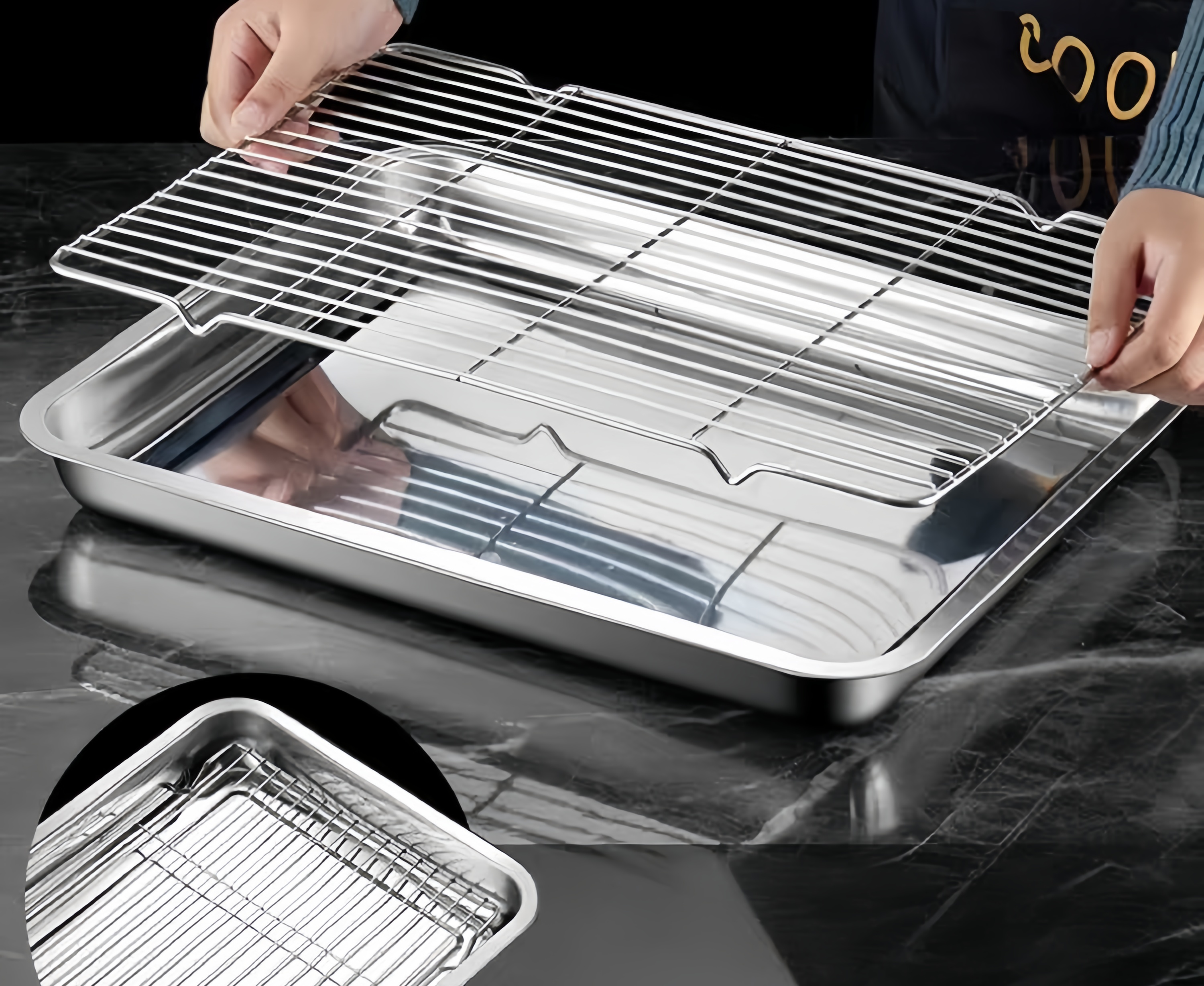
Our 스테인레스 스틸 베이킹 냉각 랙 can be produced in customized sizes, 와이어 직경, mesh openings and frame structures for commercial and industrial applications.
For customized racks, the approved product should be tested in the actual equipment before the design becomes the repeat-order standard. Critical dimensions should then be recorded on the drawing.
Do not assume that a product will fit simply because the nominal length and width remain unchanged.
5. Reuse or Verify the Production Fixture
Fixtures help control frame shape, wire spacing, component location and welding position during production.
When an existing fixture is reused, the manufacturer should check whether it is still suitable for the current drawing. Fixtures can be modified, damaged, incorrectly identified or replaced between orders.
For important customized products, buyers can ask the manufacturer to confirm:
- Fixture identification
- Applicable product code
- Applicable drawing revision
- Critical positioning points
- Condition before production
- Whether a new fixture is required
A product should not be forced onto an outdated fixture after its dimensions have been revised.
When a new fixture is prepared, a pre-production sample may be necessary before the complete repeat order is released.
6. Compare Welding, Flatness and Structure
Two racks can have the same overall dimensions but behave differently if the welding or structural support has changed.
Repeat-order inspection should include:
- Missing or loose welds
- Detached inner wires
- Uneven weld positions
- Frame distortion
- Raised corners
- Rocking support legs
- Incorrect reinforcing-wire positions
- Movement at handle connections
- Sharp projections around welded areas
Large racks, thin frames and products containing several welded components may be more sensitive to heat distortion.
The buyer should separate functional requirements from cosmetic expectations. Structural connections, product fit and safe handling usually need clear acceptance criteria. Minor appearance variations around welds should be evaluated according to the agreed sample and specification.
Photographs from the first approved production batch can provide an additional comparison reference.
7. Control Surface Treatment and Packaging
Repeat-order consistency includes more than the metal structure.
Changes in cleaning, polishing, electropolishing, handling or storage can influence the finished appearance. Packaging changes can also create scratches, bent handles, compressed legs or mixed product labels during transportation.
The confirmed order documents should identify:
- Required surface treatment
- Acceptable surface appearance
- Individual protection method
- Separator materials
- Stacking direction
- Carton quantity
- Label content
- Barcode or product code
- Pallet or wooden-case requirements
- Protection for handles and support legs
Private-label packaging should have its own approved artwork version. Old and new artwork files should not share unclear filenames such as “final,” “new final” or “latest.”
Using a date or revision number makes it easier to identify the correct packaging file.
8. Compare Inspection Records Between Batches
Inspection records from the first successful order can become useful reference data for future production.
Instead of asking only whether the repeat order “passed,” buyers can compare selected results, such as:
- Actual overall dimensions
- Actual wire diameter
- Mesh opening or wire spacing
- Product weight
- Flatness observations
- Welding findings
- Packaging quantity
- Label verification
- Photographs of completed products
This comparison can reveal gradual changes that may not be obvious when each shipment is inspected separately.
For example, every batch may technically remain within the agreed limits, but product weight or spacing may be moving consistently toward one limit. Recognizing the trend early allows the buyer and manufacturer to review the process before it creates a fitting or performance problem.
ISO’s quality management overview explains how defined processes and quality controls can improve consistency and reduce errors. This reference does not mean that a supplier is ISO-certified. Buyers requiring certification should request and verify the relevant certificate separately.
Create a Repeat-Order Control File
For each customized product, maintain one control file containing:
- Current approved drawing
- Drawing revision history
- Product specification
- Approved sample record
- Material requirements
- Packaging artwork
- Inspection checklist
- First-order inspection results
- Approval photographs
- Product and customer codes
- Special handling instructions
This information should be reviewed whenever a new purchase order is placed.
Instructions from informal messages should be transferred into the controlled file if they affect production or inspection. Otherwise, important decisions may disappear when sales staff, engineers or purchasing personnel change.
Questions to Ask Before Releasing a Repeat Order
Before approving production, buyers can ask:
- Are you using the latest drawing revision?
- Is the approved reference sample still available?
- Will the same material specification be used?
- Has the production fixture been checked?
- Have any manufacturing processes changed?
- Are the inspection requirements unchanged?
- Is the latest packaging artwork available?
- Does any proposed change require buyer approval?
These questions are more useful than simply writing “same as last order.”
Information to Send with the Purchase Order
For accurate stainless steel wire rack repeat orders, provide:
- Previous order number
- Current product code
- Latest drawing revision
- Required quantity
- Material specification
- Critical dimensions
- Surface-treatment requirement
- Approved packaging version
- Required inspection records
- Requested completion date
- Written list of any new changes
If no changes are required, state clearly that the order must follow the identified drawing, specification, reference sample and packaging version.
Consistency Protects Long-Term Purchasing
A successful sample proves that a product can be manufactured once. A reliable repeat-order process helps prove that the agreed product can be reproduced consistently.
Importers, distributors, food-equipment manufacturers and commercial kitchen suppliers should treat drawings, samples, materials, fixtures, inspection and packaging as connected parts of one product standard.
LittleMonkey Metal supplies standard and customized stainless steel wire racks and grill meshes. Have a drawing, an approved sample or a previous product that needs to be reproduced? Send us the product information, required quantity and application so we can review the manufacturing requirements for your next order.