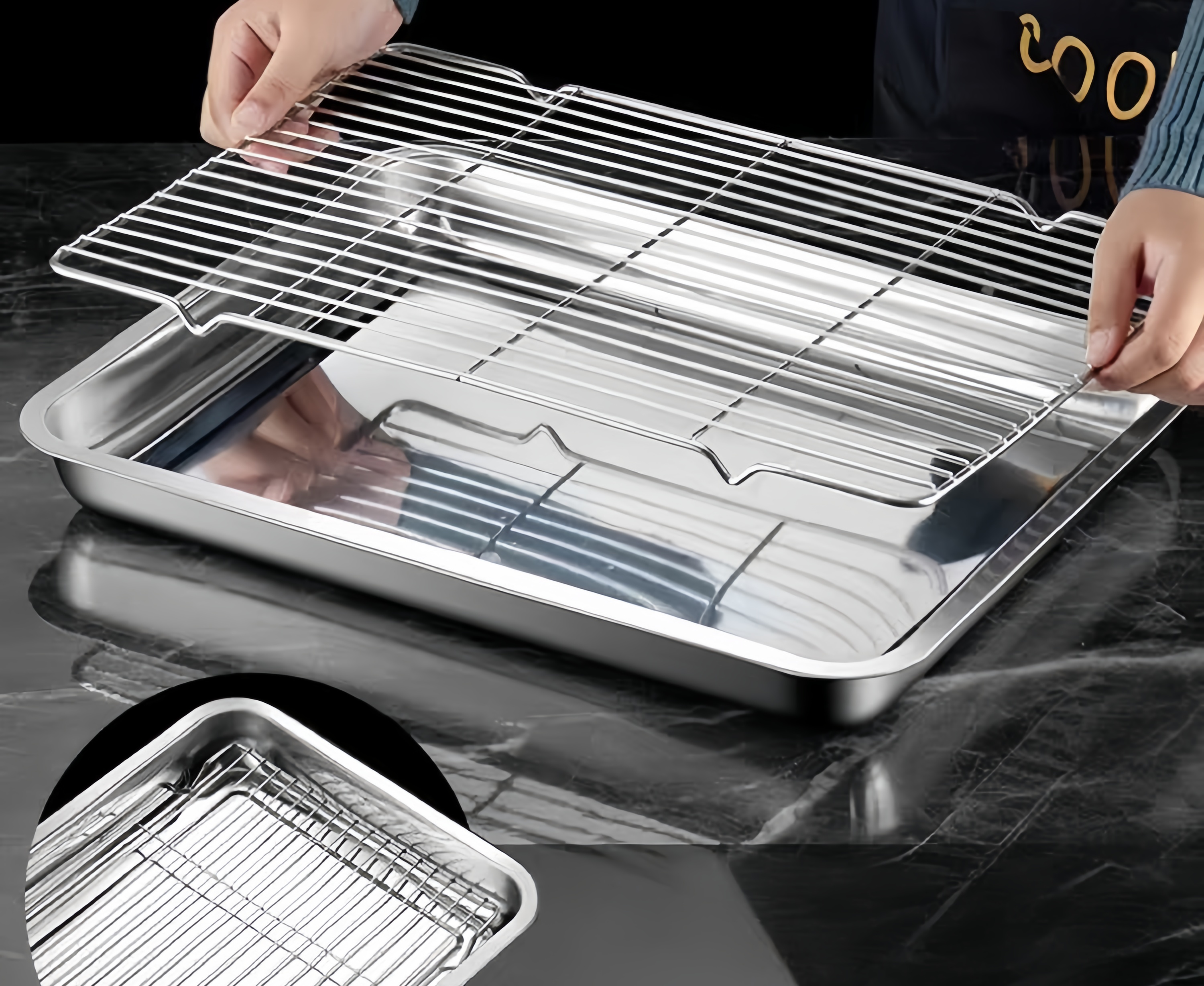

Busy barbecue restaurants do not cook under ideal conditions. A grill surface may be loaded dozens of times in one shift, moved between cooking zones and scraped clean while it is still part of a fast production routine. In this environment, the shape of the grill mesh can influence output just as much as the fuel source or cooking temperature.
A straight bar grill mesh uses parallel stainless steel wires inside a reinforced frame instead of a woven pattern. The simple geometry is well suited to whole cuts of meat, fish, large vegetables and other foods that need a stable support surface. For commercial buyers, it can also simplify cleaning, inspection and replacement planning.
1. Why Straight Bars Suit High-Volume Cooking
Parallel bars create a direct, predictable contact pattern between the food and the heat source. With fewer intersections than a woven mesh, the cooking surface is easy to understand and easy for staff to use consistently.
The design is particularly useful when the operator needs to:
- Load several large portions at the same time
- Turn food quickly with tongs or a spatula
- Maintain a consistent grill mark from batch to batch
- Move the rack between a preparation table and the fire
- Remove grease and char without working around complex crossings
Consistency is valuable in a commercial kitchen. When every rack has the same bar spacing and frame dimensions, staff can estimate capacity and cooking position without relearning the equipment for each batch.
2. Heat Conduction and Cooking Control
Stainless steel bars transfer heat to the food along defined contact lines. The open spaces between bars allow hot air and smoke to pass around the product, while the bars provide the direct contact needed for browning.
The balance depends on three related dimensions:
- Bar diameter: Thicker inner wires generally tolerate more weight and prolonged heating. They may also create more pronounced contact marks.
- Bar spacing: Closer spacing supports smaller pieces and reduces the risk of food falling through. Wider spacing increases the open area for airflow and direct heat exposure.
- Frame size: A larger rack needs enough perimeter strength to stay flat and maintain the intended spacing when loaded.
Changing one dimension can change the cooking result. For example, reducing the spacing without reviewing the wire diameter may make a rack heavier than expected, while using thin bars across a long span may allow deflection under a full load.
3. Selecting Spacing for Different Foods
The best spacing is determined by the smallest food item that must remain secure, not by the largest item placed on the rack.
Whole cuts, steaks and ribs
Large cuts are usually compatible with wider spacing because the food bridges several bars. Wider gaps can improve airflow and make it easier to scrape residue from the surface. Confirm that the gap still supports the product after it softens during cooking.
Fish fillets and delicate portions
Fish can become fragile as its internal moisture changes. Closer bar spacing gives the fillet more support and reduces the chance of it breaking when transferred. If the kitchen uses a spatula, spacing should also allow the tool to slide under the food without catching on a large gap.
Vegetables and mixed platters
Large peppers, corn, eggplant halves and similar vegetables work well on a straight-bar surface. For mixed platters, select spacing based on the smallest loose ingredient or use a removable insert for small foods.
The manufacturer can adjust inner wire spacing to match a menu, a cooking temperature range or a specific grate. Providing actual food dimensions is more useful than describing an application as simply “commercial BBQ.”
4. Frame Strength Is a Daily Productivity Feature
A frame does more than hold the bars in place. It determines whether the rack can be lifted, stacked and cleaned without losing its flatness.
For heavy-duty use, buyers should review:
- Frame wire diameter and corner construction
- Inner wire diameter and support span
- Weld continuity at every bar-to-frame joint
- Reinforcement required for larger lengths or widths
- Clearance between the frame and the existing grill grate
A rack that rocks on the cooking surface creates uneven browning and makes turning food harder. A rigid frame keeps the bars at a consistent height and reduces the need for staff to compensate with manual repositioning.
5. Cleaning Is Faster When the Geometry Is Simple
Commercial BBQ equipment accumulates grease, sauce and carbonized residue quickly. Straight bars present long, accessible surfaces that can be brushed in one direction. The open structure also makes it easier to see whether residue remains after washing.
Cleaning performance still depends on finish and weld quality. A smooth electropolished surface helps reduce residue adhesion, while clean welds without sharp projections prevent food particles from catching at the joints.
Establish a standard cleaning routine for each shift:
- Remove loose residue with a suitable grill brush or scraper.
- Allow the rack to cool to a safe handling temperature.
- Wash with an appropriate detergent and non-abrasive pad.
- Rinse thoroughly to remove grease and cleaning chemicals.
- Dry the rack before stacking or storing.
- Check for broken bars, opened welds or a frame that no longer sits flat.
This routine supports hygiene and gives managers an early warning when a rack should be repaired or replaced.
6. 304 vs. 201 Stainless Steel for Commercial Orders
Material selection should reflect the cleaning frequency, moisture level and service expectations of the target market.
304 stainless steel is commonly chosen for high-frequency food-service use because it offers strong corrosion resistance and food-contact performance. It is a practical option for restaurants, hotels, caterers and equipment distributors that expect repeated washing and long service life.
201 stainless steel can be considered for cost-sensitive projects or moderate-frequency applications when it meets local requirements. Buyers should confirm the grade, surface treatment and documentation needed for their market before approving production.
Regardless of grade, the finished rack should have smooth edges and secure welds. A lower-cost material does not justify unfinished joints or surfaces that are difficult to clean.
7. When a Straight Bar Grill Mesh Is the Better Format
Straight bars are often a strong fit when the main priorities are load-bearing, large food portions and quick maintenance. A woven or fine mesh may be preferable when the menu contains many small ingredients, but a straight-bar format can reduce complexity for a focused commercial menu.
For restaurants and outdoor vendors, a straight bar stainless steel grill mesh provides a heavy-duty base that can be customized for length, width, bar diameter and spacing. Handles, feet or connectors can also be discussed when the rack must integrate with a particular cooking line.
The right choice is not about copying a standard shape. It is about matching the surface to the menu, equipment and staff workflow.
8. What to Send in an OEM or Wholesale Inquiry
Suppliers can quote more accurately when the request includes operating details as well as dimensions. Add the following information to the RFQ:
| Specification | Information to Include |
|---|---|
| Food and portion size | Typical and smallest pieces cooked |
| Equipment | Grill, smoker, oven or custom cooking line |
| Overall dimensions | Usable length, width and required clearance |
| Frame | Wire diameter, corner style and reinforcement |
| Inner bars | Diameter, quantity and center-to-center spacing |
| Material | 304 or 201 stainless steel |
| Surface finish | Electropolished or another approved finish |
| Handling | Fixed rack, removable rack, handles or feet |
| Load | Maximum food weight per rack |
| Order plan | Sample quantity, trial order and forecast volume |
| Packaging | Bulk carton, individual box or private label |
Include a drawing or a photograph with a ruler whenever possible. If the rack must replace an existing model, send a physical sample or record its internal dimensions, bar spacing and frame height.
9. A Practical Sample-Approval Checklist
Before mass production, test the sample in the actual cooking environment. Confirm that the rack fits the grate or shelf, remains stable when loaded and can be lifted with the tools used by staff.
During the test, inspect heat distribution across the center and edges. Check whether the spacing supports the smallest menu item and whether larger portions can be turned without sticking. After cooking, review how quickly grease can be removed and whether any weld or corner traps residue.
Finally, measure the sample against the approved drawing. Small changes in spacing or frame height can affect how the rack fits a production line, so dimensional approval should happen before the purchase order is released.
Frequently Asked Questions
Is a straight bar grill mesh only for restaurants?
No. It is also suitable for caterers, food trucks, outdoor events and home users who cook large portions. Commercial kitchens benefit most from its load capacity and simple cleaning geometry.
Will straight bars prevent small foods from falling through?
They can when the spacing is selected for the food size. For very small ingredients, specify closer spacing or use a finer mesh insert designed for that menu.
Can the bar spacing and frame be customized together?
Yes. Buyers can request different inner wire diameters, spacing, frame sizes and reinforcement. A drawing or sample helps the manufacturer confirm the complete design.
Does a thicker bar always mean better performance?
Not always. Thicker bars improve strength, but they can add weight and change contact marks. The best diameter balances load, span, heat behavior and handling requirements.
Final Takeaway
A straight bar grill mesh is a workflow tool as much as a cooking surface. Its parallel-bar structure can support large portions, deliver repeatable contact heat and make cleaning more straightforward, provided the spacing and frame are designed for the real menu.
For OEM and wholesale projects, share food sizes, equipment clearances, load expectations and cleaning routines with the manufacturer. A sample tested on the actual grill is the fastest way to confirm that the final design will perform through every busy service.